
Stop Rebuilding Metrics That Already Exist
Teams reuse governed definitions instead of paying to recreate them, and valuable definitions surface automatically instead of dying in one repo.
Enterprise Semantic Layer & Metric Governance
Canonical turns scattered metric logic into one governed, reusable source of truth. Every metric is defined once, approved by its owner, and used the same way by every BI tool, notebook, pipeline and AI agent.
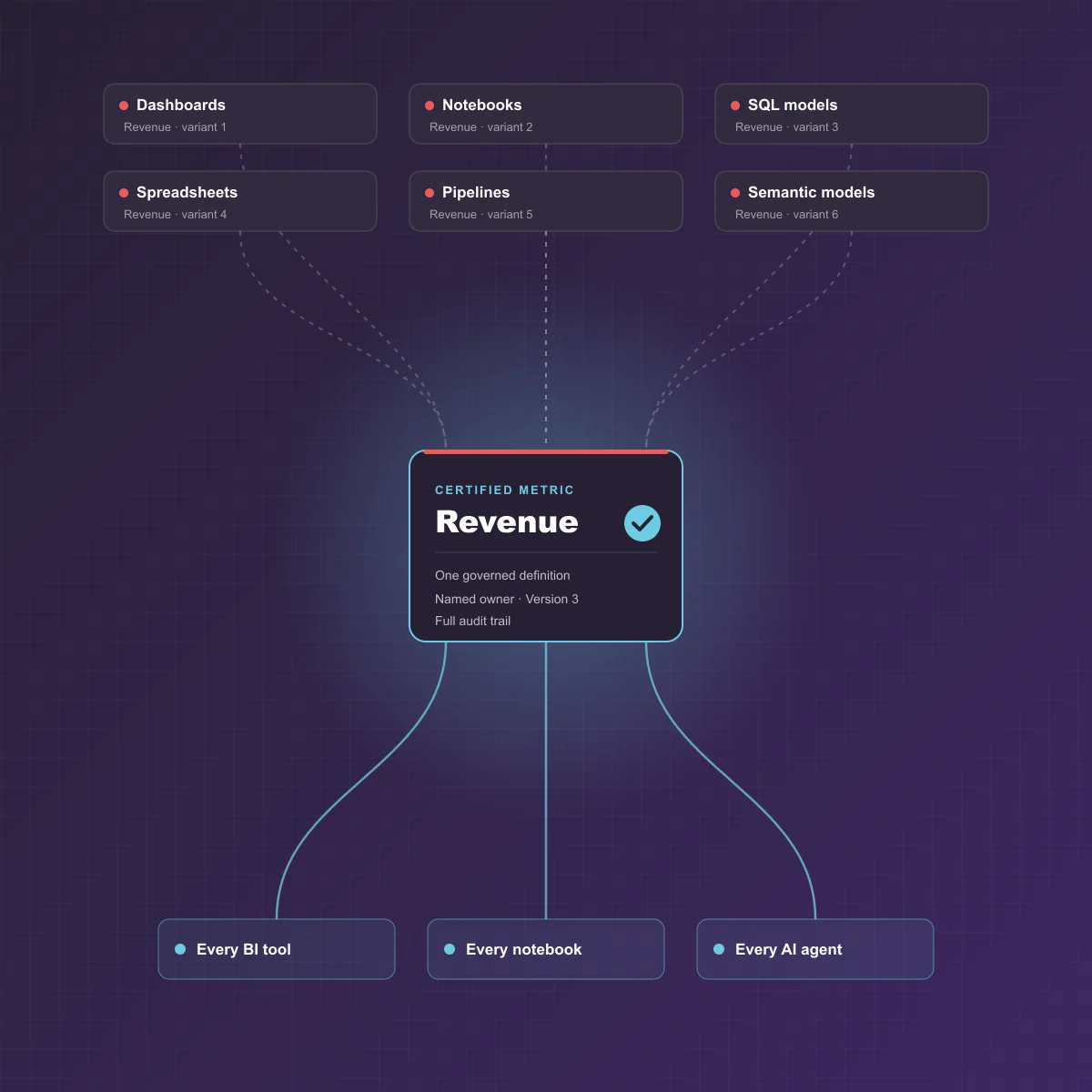
Critical business metrics live as hand-written YAML, spreadsheets and code buried inside individual teams, repos and regions. Every BI tool, notebook and pipeline re-implements the same logic its own way, so "Revenue" can mean five different things across five dashboards, and no one can prove which is right. Teams rebuild metrics that already exist elsewhere, definitions stay locked inside one business unit, and leadership loses confidence in the numbers. Now AI agents are querying data on their own, and they inherit every one of those inconsistencies. The result is duplicated effort and no enterprise-wide source of truth. A semantic layer closes that gap: one place where each metric is defined once, governed centrally, and resolved the same way by every tool that queries it.
Canonical runs two paths that meet in one certified library. Strategic, board-level metrics are authored directly by their owners. Long-tail metrics are discovered at scale across code, tools and data, then drafted for review and never auto-published. Authors define metrics in a drag-and-drop, YAML-backed builder with full SQL editing, while SMEs run scans, review ranked candidates and manage the approval queue in a separate discovery console.
Agentic scans search everywhere metric logic already lives and surface candidate definitions.
Candidates are prioritized so subject-matter experts review the highest-impact metrics first.
In the adjudication workspace, SMEs compare variants side by side, like a pull request for metrics.
Approved metrics are promoted to the canonical library, instantly discoverable and reusable by every team, tool, geography and AI agent.
As AI agents query data on their own, Canonical checks their logic against approved definitions in real time, so AI-generated business logic cannot drift away from what the business has certified.
“An agent queried something that looks like a ‘blended margin’ metric 47 times today. It doesn’t exist in your semantic layer. Want to review and formalize it?”
The agent used an approved definition correctly. Logged automatically, no action needed.
The agent used a known metric with a slightly different formula. Flagged as a candidate for the next review cycle.
The agent created logic that doesn't exist in the library. A discovery notification goes to the owning SME.
Teams reuse governed definitions instead of paying to recreate them, and valuable definitions surface automatically instead of dying in one repo.
One governed definition replaces conflicting spreadsheet math across dashboards.
Trusted metrics are available on demand, not weeks away, so leaders act on the right number the first time, not the third.
Metric logic outlives individual authors, teams and turnover.
Every published metric carries a named SME or data steward and a complete history.
Globally distributed teams build on the same catalog and one enterprise standard, and respond to market shifts without waiting on metric plumbing.
Align sales, margin and customer metrics across merchandising, digital and store reporting.
Standardize volume, share and trade-spend metrics across brands, regions and retail partners.
Give plants and leadership one definition of yield, downtime and quality across sites.
Govern product, usage and revenue metrics across engineering, finance and go-to-market teams.
Reconcile audience, engagement and advertising metrics across platforms and partners.
Keep risk, revenue and customer metrics consistent across business units and regulatory reporting.
No metric is ever published without a human in the loop. Canonical applies three trust tiers, proportionate to business impact. Tier 1, Human-Only: board-level and earnings-call metrics such as net revenue, gross margin and active customers need a named approver, and the system blocks any agent or scan from modifying them. Tier 2, Standard Review: most business metrics go through full SME or data steward review before certification. Tier 3, Light-Touch: operational, low-stakes metrics can be suggested automatically and go live with lighter review, for speed where the risk is low. Every approval is committed with a full audit trail and version history. Queries resolve through the semantic layer, not around it, and Canonical is built on open, interoperable components with a MetricFlow-style core, so it plugs into the stack you already run (Databricks, Snowflake, SQL and dbt) instead of becoming a walled garden.
Turn scattered tribal knowledge into a trusted, enterprise-wide metrics catalog: discoverable, governed and ready to reuse.